Happy New Year to y’all! From my greeting you will have gathered that our recent holiday in New Orleans has rubbed off on me a bit - great place to visit but not just before Christmas if you’re trying to lose weight! Tom Cruise was in town while we were there filming the second Jack Reacher movie - had I but known I would have offered up Junior as a possible stunt double (yes, that’s right, you thought it was really Tiny Tom climbing all those buildings and jumping off planes in the Mission Impossible movies, but it is really all clever trickery and toddlers!)
I have decided to do a new post because for the first time in several years I have actually found myself vaguely interested in some of the TV that was on over Christmas. There is a common theme between the main productions I will be reviewing here (Sherlock, And Then There Were None, and indeed my cinema jaunt to see Star Wars: The Force Awakens, which I will throw in for good measure), as it feels as if I had been waiting for all of them for a very long time indeed (the exception being Dickensian, which just sort of turned up but now seems to be lingering). Warning - THERE WILL BE SPOILERS! LOTS OF SPOILERS!
Sherlock
Let’s get Sherlock out of the way first, shall we? From the reviews I have seen it looks like more than half of viewers thought it was utterly fantastic, but a significant minority found themselves rather mystified and muddled. I fall somewhere in between, in that I did at least understand what was going on (it’s basically Sherlock does Inception via Suffragette) but found myself frustrated that it was not what I was hoping for or expecting.
From the trailers it appeared that what Messrs Gatiss and Moffatt were going to offer us was a genuine “stand alone”, Victorian-set Sherlockian chiller. I was VERY much in favour of that idea. Ever since Cumberbatch and Freeman took on the mantles of Holmes and Watson, my one tinge of regret was that I always assumed that it effectively precluded them from ever playing the roles in a Victorian setting, which I always thought that they would do very well.
When I heard that in the next episode of Sherlock they were proposing to do just that, I therefore got rather excited. For a Christmas episode, no less! One of my favourite Sherlockian dramatisations of all time is the hammily delicious Jeremy Brett version of the Blue Carbuncle. But this was going to be different - it had a supernatural element to it! So much the better - Christmas is a good time for ghost stories. I wanted to be scared. I wanted them to create a mysterious, gaslit, frightening atmosphere. I was expecting goosepimples! What we got instead was Sherlock hallucinating about dressing up in a silly costume for an hour and a half whilst pepper-spraying the viewers with twenty “in-jokes” a minute, then waking up, getting off a plane and into a car! That was it.
Unfortunately it is next to impossible for a production to be both atmospheric and “knowing”, and this was a “nudge nudge wink wink” production down to its fingertips. By the end my ribs were bruised from all the nudging and Gatiss and Moffatt have been winking at their audience for so long now that unfortunately it appears to have developed into a nervous tic that they can’t quite shake off. The first two seasons of Sherlock were great because they kept all the “stuff going on in Sherlock’s mind” to a minimum - every once in a while we would have him going to the scene of the crime in his mind and moving stuff around, and that was fine because the filmmakers were using the technique sparingly. But then they started overdoing it in season 3 and they really went into overdrive here to the extent that at times it’s getting close to unwatchable.
So there we were, jumping back and forth between present day Sherlock, Victorian era Sherlock, and a few weird scenes that combined the two (featuring everyone’s favourite twinkly Irish supervillain Moriarty, who isn’t going to let a little thing like being dead stop him from yammering on about how clever he is), and by the end I was getting more than a little fed up with it and got close to yelling “Just pick an era and sodding well STICK to it!” at my TV screen.
Of course it all turned out to be drug induced. What a surprise! Perhaps it is just me being puritanical, but what really frustrates me is the way that virtually every Sherlock Holmes film or TV film since the Brett era seems to have latched on like overexcited limpets to Sherlock’s drug habit, as if that was the most interesting thing about him (especially the 2002 Hound of the Baskervilles and that weird one with Rupert Everett - ironically the Robert Downey Jr version wasn’t too bad on this front!) It is IN NO WAY the most interesting thing about him! It is something that Conan Doyle made a passing reference to in two or three of the sixty original stories but it was never something that he spent pages and pages banging on about, for the obvious reason that he was busy telling gripping stories. Until now Gatiss and Moffatt had resisted the temptation to “make it all about the drugs” but unfortunately they couldn’t resist it this time.
A plot did manage to winkle its way in there somewhere, and it was all about a gang of feminists teaming up to “right society’s wrongs” by, er, killing that guy who played Percy in Blackadder. Whilst supportive of the concept, I make no claim to be an expert on feminism, but it was hard to miss that this was a bizarrely misogynistic way of coming out in support of the feminist movement! This point was not lost on Buzzfeed either (there was much talk of “mansplaining”), but luckily most of the great unwashed viewing masses were probably too confused by this stage of the show to get offended.
Similarly, I did feel that Amanda Abbington as Mary is getting slightly short shrift - I get that Gatiss and Moffatt are working their little cotton socks off to try to remedy the lack of strong female characters in the books and I applaud them for doing so (the character of Mary in the original novel “The Sign of Four” is particularly insipid and spends most of the time crying on people’s shoulders - clearly the writer of the play Crucifer of Blood, later turned into a turgid film with Charlton Heston, thought the same, although he went for the simpler approach of just turning her into a serial killer). The trouble with the Gatiss/Moffatt version of Mary is that when every line she is given seems to be a variant of “I am stronger/cleverer than you”, rather than having the scriptwriters actually working to create a fully rounded three dimensional character that the audience can make its own mind up about (“show, don’t tell - more on this later in the context of Star Wars), it starts to get rather tiresome. Having said that, the show does boast some genuinely strong female characters, Molly Hooper foremost amongst them, and there are many shows still being made that don’t even manage that, so let’s not beat them up too much!
All these negatives aside, the film did pass Mark Kermode’s famous “six laughs” test comfortably (I was chuckling throughout) and there were some great moments. Particular highlights for me were Mrs Hudson lamenting her lack of lines in Watson’s stories and consequently refusing to speak to anyone (Una Stubbs may just be the best thing in the show); Martin Freeman managing to turn in a fine authentic performance as “Victorian Watson” in spite of all the gimmicks (is it me, or is he starting to age into Ian Holm for real now?); moustachioed Molly; and of course fat Mycroft (just a wafer thin plum pudding or two away from Mr Creosote). I will undoubtedly watch it again (along with all the others) and will probably enjoy it more the second time round as I won’t be expecting something M R James could have written.
Dickensian
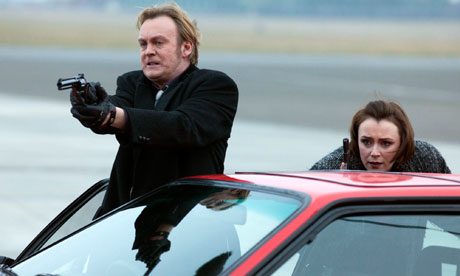
Luckily we were not left at a loss for something more typically festive, and I’m not talking about Phil Mitchell’s annual tradition of smashing up the Vic with a baseball bat with an ironically jaunty Christmas tune playing in the background (“leave it aaaht”). Succour came in the form of Dickensian, a multi part mystery set seven years before A Christmas Carol and dealing with the murder of Jacob Marley, featuring what can only be described as an eccentric smorgasbord of suspects from various Dickens novels, from Scrooge (Ned Dennehy apparently doing an impression of Prince Philip doing an impression of Alistair Sim), to Fagin (Anton Lesser proving that Ron Moody may be no longer with us but his twinkly pickpocketing spirit lives on). Heck, even “Little Nell” is a suspect.
This one’s rumbling on for a few weeks so I still don’t know whodunnit (my money’s on Tiny Tim), nor, in truth, do I particularly care, but it is an undemanding and vaguely diverting way of passing the time even though (or perhaps because) it involves a lot of familiar looking thesps doing their best “Christmas pudding” acting (often overcooked, extremely fruity and not quite as delightful as it thinks it is). I suspect that they have been urged to overact as much as possible in order to distract from the ludicrously fake backdrops.
And Then There Were None
This, a 3 part adaptation of Agatha Christie’s darkest novel, is a mystery of an altogether more sombre nature. I became a fan of this novel at the age of 14 when I spotted a very dog eared copy of an old edition being sold off by my secondary school library for 50p. When I say “old edition” it really must have been, as it still bore the original, highly racist title it was published under in 1939, or “before racism was bad” as David Brent would put it (which perhaps explains why Sevenoaks School, with its almost militantly “internationalist” approach, was so desperate to get it out of its library as quickly as possible!)
It was later republished as Ten Little Indians (as each of the murders that is committed in the novel is based on a line of the nursery rhyme) but “Indians”, although an improvement on the word it replaced, was also judged to be inappropriate for a 21st century adaptation,, so we have the slight but probably unavoidable incongruity of ten people from the 1930s, some of whom, it is clear from the script, are horribly anti-semitic, homophobic or just generally intolerant, nonetheless being sufficiently enlightened to refer to the “Ten Little Soldier Boys” nursery rhyme.
In truth, Christie should have known better even in 1939 than to scatter the pages of her novel so liberally (or “illiberally”) with so much casual racism, but what is equally true is that in spite of this uncomfortable and grubby drawback, the book is a classic and has undoubtedly inspired hundreds if not thousands of imitators (including the Alien franchise). A detective story with no detective, it soon becomes clear that no-one is safe from the mysterious “Mr U N Owen” (think about it - it’s a tricky one) who has lured ten strangers, each of whom may or may not have committed a murder or two themselves in the past, to a remote, inaccessible island, to punish them for their crimes by one by killing them off in increasingly elaborate ways, only for it to turn out that he (or she) is in fact one of them. But which?
This is actually the sixth film adaptation of the novel, with the classic version remaining Rene Clair’s 1945 adaptation featuring a veteran cast of scene stealers including Barry Fitzgerald, Walter Huston, C Aubrey Smith and Judith Anderson, all of whom find themselves upstaged (and outlived) by the resident cat (who wasn’t in the book and rather disappointingly does not turn out to be the murderer).
I have also seen the 1960s version (with the action moved from the island in the novel to a remote Swiss chalet - it isn’t bad, but the Shining it ain’t) and the 1970s version (set in the desert - this was the one where the murderer inexplicably makes an early mistake of allowing Charles Aznavour to get through a whole song BEFORE poisoning him). I haven’t seen the Russian version or the 1989 version, which is reportedly rather terrible and starred Sylvester Stallone's brother Frank (remember him? Me neither!) As far as I am aware though, up to this point all of the adaptations have shunned the “dark” original ending (spoiler: absolutely everyone dies) in favour of the alternative ending which Christie herself used in her own stage adaptation of the novel, where MOST people still die but two of the guests turn out to (a) be innocent and (b) survive. So it was clear to me that there was room for at least one more version, this time faithful to the original ending. Clearly the BBC had the same idea. Don’t go looking for happy endings.
Does it work? More or less - the problem is that all of the characters are now so unsympathetic that at times I found myself actually rooting for the killer. This was also true up to a point in some of the previous adaptations, but at least in those versions the characters were fun to be around (and not only the two innocent ones, the other victims/suspects were also generally portrayed with eccentric charm that I couldn’t help liking them in spite of their “crimes”, at least in the 1945 and 1965 versions). Here, the original ending is retained but several of the characters’ backstories are changed to make their crimes even more heinous than they were in the book, which I think was an unnecessary step as it only served to repel the audience more.
There are exceptions, such as Sam Neill as the general (Sam Neill can never be truly dislikeable), Toby Stephens as the doctor (who is keeps getting so amusingly hysterical that one can’t help feeling a bit sorry for him), and Charles Dance as the judge. I always used to think that Charles Dance was essentially Ian Richardson without the twinkle in his eye, but I wonder whether Richardson bequeathed Dance his “twinkle” in his will, as recently the latter appears to have developed an oddly sympathetic streak, which strangely seems to come to the fore mostly when portraying characters who in the novels are singularly “untwinkly” (this was the case here and also in Game of Thrones).
The other acting is also fine, although Anna Maxwell Martin is not given enough to do (it feels as though she is only given a few brief moments to develop her character, which she does excellently, before being ignominiously bumped off). Noah Taylor as the butler is shifty and sinister, Burn Gorman as the bent copper seems to be channeling Billy Mitchell from Eastenders, and Miranda Richardson is truly venomous (or rather her character is - I won’t hear a word said against Queenie!) Oh, and, somewhat unusually, Aidan Turner finds an opportunity to get his top off (I think may have been treating his role as a callous mercenary as a 007 audition - good actor, but not sure he has the presence).
The action is spread over 3 hours, which is quite a lot for a slender novel, but this actually works pretty well as it serves to prolong and heighten the tension (although there may have been one or two flashbacks we could have lived without - I guess we’re just lucky that Peter Jackson didn’t get his mitts on it). All in all I would put this one down as a success (albeit a bit dark for Christmas), although it lacks the charm of the 1945 version, which in my book remains as close to definitive as we are likely to get.
Star Wars: The Force Awakens
I won’t go on too long about this one as I suspect that most readers might have heard a bit about the film already (and some of you might even have seen it!) I must admit that after the prequels I was working very hard not to get my hopes up, especially as I haven’t been a particular fan of JJ Abrams’ previous work (I got lost during Lost, probably because I made the foolish decision to try to dip into it in the middle of the run, and while the Star Trek remake was OK, I thought that Leonard Nimoy was by far the best thing in it, and when the best thing in your reboot is the character from the original, you know you’re in trouble).
Actually, my view is that the prequels are not quite as bad as everyone says they are and they do have their moments (Christopher Lee vs Yoda, anyone), BUT they don’t hold a candle to the originals. One of the most telling comments about the prequels came from the “fan” who challenged anyone to describe any of the characters without using a physical description or describing “what they do”. With the original trilogy this exercise is fairly easy, but with the prequels it is nigh on impossible (which is a particular shame when one considers that the main characters are just younger versions of the iconic characters brilliantly fleshed out by James Earl Jones and Alec Guinness in the originals, people who we just “knew” from their performances had intriguing backstories - we didn’t NEED to see those backstories and perhaps it would have been better if we hadn’t). Guinness in particular was a master of the “show, don’t tell” technique - he was able to tell the story of the prequels infinitely better in a few seconds with a pained pause and a raised eyebrow than Lucas did in three films, despite all the filmmaking magic at his disposal.
Luckily JJ Abrams remembered to create real characters this time, meaning that the new characters of Rey (Daisy Ridley), Finn (John Boyega), new baddie Kylo Ren (Adam Driver making Darth Vader look positively cuddly by comparison and giving the performance that Hayden Christensen SHOULD have given as Anakin in the prequels) and intrepid pilot Poe Dameron (Oscar Isaac, having to contend with more limited screen time than the other three as well as the fact that his character was named after a Teletubby), are all on course to become iconic characters in their own right in the same way that Luke, Han and Leia did back in the day. If anything, I found some of the “cameos” from the original cast a little distracting (I love R2D2 and C3PO to bits but they didn’t really add much here, especially given that the new droid BB8 is so charming). Having said that, Han and Chewbacca are given quite a lot to do (the latter even gets to engage in a bit of growly flirtation with Dame Harriet Walter, and both are a joy to watch (even if Harrison Ford does spend most of the film looking as if he’s just woken up from a nap).
Ultimately I did find it all very exciting and entertaining despite certain feelings of deja-vu (discussed below) - my only other real criticisms were that (a) the happy ending from Return of the Jedi (otherwise known as Star Wars Episode VI: The All Powerful Intergalactic Empire Gets Itself Thoroughly Spanked by a Small Band of Ewoks With Sticks) is now completely ruined (I’m sorry but Han and Leia would NEVER split up so I’m going to pretend I just misheard those lines of dialogue) and (b) Abrams obviously doesn’t understand how fast light speed actually is (i.e. too fast to approach a planet or a Death Star if you don’t want to end up as flat as a pancake) any better than Lucas did, but if you can’t suspend your disbelief in a Star Wars film then when can you?
What did surprise me is just how closely it mirrors the plot of the original film, with Han taking on the Obi Wan role this time round (always a strategic error and sadly this proves to be no exception) and Luke Skywalker looking set to be the new Yoda! Not that it really matters this time round - it’s a good formula so why not stick to it? Disney may run into trouble however if they make a habit of it - if they are planning to release a new Star Wars film every year they are going to have to work exceptionally hard to keep the franchise feeling fresh and original. It’s easy to get excited about this one given that its was the first film for 10 years (or 32 years if you really hate the prequels, or 35 years if you hate the prequels AND the Ewoks!) but the filmmakers won’t have that advantage next time. My own view is that a film a year is going to be serious overkill and it would have made more sense to stagger them (and if they start recasting characters I think they’ll really run into problems). Nevertheless, if they are all as good as this one (or even almost as good), I shall probably keep watching them anyway.